New DOT Drug Testing: What Employers and Drivers Need to Know
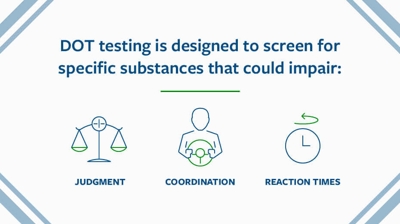
In the world of transportation and logistics, safety is everything. That’s why the Department of Transportation (DOT) mandates drug and alcohol testing for employees performing safety-sensitive functions. These regulations are designed to protect public safety by ensuring workers remain drug- and alcohol-free while on the job.
In 2025, new DOT drug testing requirements will take effect, including the long-awaited implementation of oral fluid testing. These changes represent a significant update to compliance protocols. Employers and employees should stay informed to avoid unintentional, yet costly violations.
This guide provides HR managers, fleet operators and safety-sensitive employees alike with clear guidance on DOT testing rules, updates and next steps.
Who is Subject to DOT Drug Testing?
Federal DOT drug and alcohol testing applies to individuals working in safety-sensitive positions across multiple transportation sectors. It’s not about job titles — it’s about duties that, if performed under the influence, could threaten public safety.
Examples include:
- Commercial Driver’s License (CDL) drivers: Regulated by the Federal Motor Carrier Safety Administration (FMCSA)
- Airplane mechanics, flight crews and pilots: Regulated by the Federal Aviation Administration (FAA)
- Train engineers and operators: Regulated by the Federal Railroad Administration (FRA)
- Transit vehicle operators: Regulated by the Federal Transit Administration (FTA)
- Pipeline workers: Regulated by the Pipeline and Hazardous Materials Safety Administration (PHMSA)
- Maritime crew members: Regulated by the United States Coast Guard (USCG)
New DOT Drug Testing Requirements
In May 2023, the DOT finalized new rules permitting oral fluid — saliva — testing as an alternative method to urine testing. Beginning in 2025, employers will be able to implement saliva drug testing, provided that two labs certified by the Department of Health and Human Services (HHS) become operational.
Benefits of oral fluid testing include:
- Reduces the possibility of cheating, as samples are collected under direct observation
- Enables faster detection of recent drug use, typically 24-48 hours
- Easier to observe while preserving employee privacy
Oral fluid tests will apply in these testing scenarios:
- Pre-employment
- Random
- Post-accident
- Reasonable suspicion
- Return-to-duty
- Follow-up tests
Employers should update their workplace drug and alcohol policies in advance to prepare for implementation.
What Substances Are Tested in DOT Drug Testing?
DOT-regulated drug tests use a five-panel test to detect specific substances. Both urine and oral fluid tests follow these SAMHSA-recommended cutoff levels
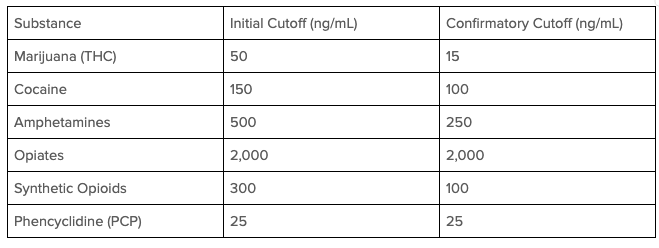
It's important to note that DOT alcohol tests detect concentrations of 0.02 or higher, and that CBD products can trigger THC-positive results. Even trace THC amounts in CBD could cause a violation under DOT rules. Safety-sensitive employees should therefore avoid products containing CBD.
How Is DOT Drug Testing Conducted?
There are several types of DOT-compliant drug testing methods, each with unique characteristics. The main types of DOT drug testing include:
Urine Testing
- Urine testing is the most common testing method.
- Urine is collected in private unless direct observation is required.
- Samples are sent to SAMHSA-certified labs for analysis and confirmation by a Medical Review Officer (MRO).
- The detection window is two to five days for most drugs.
Oral Fluid Testing (New in 2025)
- The saliva sample is collected in full view of the collector.
- A Chain of Custody Form (CCF) is completed immediately after the sample is collected.
- The results for this type of test are faster for recent drug use, typically 24-48 hours.
- The sample is sent to HHS-certified oral fluid labs (as soon as they are operational).
Hair Drug Testing
- The detection window for hair drug testing is up to 90 days.
- This type of test has a slower turnaround time but provides long-term use history.
Nail and Sweat Testing
- Nail testing has a long detection window.
- Sweat testing is ideal for continuous monitoring over extended periods.
Timing Matters
- Post-accident drug testing must be completed within 32 hours.
- Post-accident alcohol testing must be completed within eight hours.
- Employees must test negative on a return-to-duty test before resuming work duties.
When Are DOT Drug Tests Conducted?
DOT mandates drug and alcohol testing at multiple stages of employment, including:
- Pre-employment: Testing is required before performing any safety-sensitive duties.
- Post-accident: After qualifying accidents, testing must be conducted promptly.
- Random testing: Conducted throughout the year, random testing is delivered on a randomized basis.
- Reasonable suspicion: This type of testing is initiated when trained supervisors observe signs of substance use or abuse.
- Return-to-duty: After a drug or alcohol violation
- Follow-Up: After a series of unannounced tests for up to 5 years.
What Conduct Is Prohibited by DOT Drug and Alcohol Policies?
DOT rules are strict to protect lives and prevent accidents. Prohibited behaviors include:
- Using alcohol within four hours of duty, or eight hours for flight crews
- Testing positive for any prohibited substance
- Refusing to take a test or tampering with the process
- Using marijuana or other illicit drugs, even off duty
An employee who refuses to test can be immediately removed from a safety-sensitive role.
It’s important to note that many products are not THC-free and that even trace amounts can lead to a positive test result. Additionally, prescription medications must be declared and taken as directed by a doctor’s written instructions.
DOT Drug Testing Rates by Agency
DOT agencies each set annual testing rates. Here's a look at 2025 DOT random testing rates:
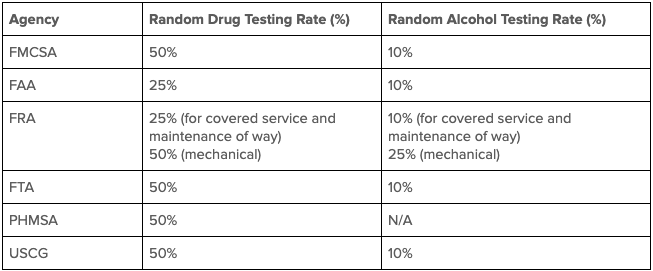
Note: These figures change annually based on DOT agency updates.
Stay Compliant with DOT Drug Testing Rules With Fastest Labs
Staying compliant with the new Federal DOT drug testing requirements takes careful planning, and Fastest Labs is here to support you every step of the way.
We help employers select a designated employer representative, maintain accurate records, including chain of custody forms, training documentation, and random testing logs, and update workplace policies to reflect the latest regulatory changes. Our team is well-versed in DOT, HHS, and SAMHSA regulations, delivering accurate, fast, and compliant DOT testing you can trust.
Let Fastest Labs be your partner in maintaining a safe, drug-free, and reliable workforce. Find a Fastest Labs location near you to get started.