


A paternity test plays a critical role in resolving questions about biological parentage. Whether for personal clarity or legal action, DNA testing is often the most reliable method for confirming a biological relationship between a child and an alleged father. But not all DNA tests are created equal — especially when legal matters are involved.
In legal cases, such as custody battles, immigration filings, inheritance claims, or child support orders, a court-admissible paternity test is essential. These tests follow specific protocols that ensure the results are legally valid and recognized by courts and government agencies.
This guide breaks down what’s involved in court-admissible paternity testing, how the process works, types of paternity testing available, and tips on choosing the right provider for your needs.
What Is a DNA Paternity Test?
A DNA paternity test is a genetic analysis that compares a child’s DNA with the potential father’s DNA to determine if they share a biological relationship. These tests are over 99.99% accurate when processed by an accredited lab, making them the gold standard for verifying paternity.
Common sample types include:
- Buccal swabs — collected from the inside of the cheek
- Blood samples
- Fingernail clippings
- Hair — including the root
- Saliva or semen
Among these, buccal swabs are the most widely used due to their ease of collection and non-invasive nature. However, all types of DNA paternity tests are highly reliable when performed under proper conditions by an accredited lab.
When and Why Is a Legal DNA Test Required?
There are many scenarios where a legal paternity test is not only helpful but also required by law.
Common legal situations include:
- Custody and child support cases ordered by a judge
- Family-based immigration petitions where proof of relationship is required
- Adoption proceedings to confirm biological parentage
- Inheritance disputes where biological ties determine legal claims
- Birth certificate corrections or additions
In certain jurisdictions, obtaining a paternity test without consent may be restricted or even considered illegal. For example, in Texas, courts may require mutual consent or a court order for legal testing.
For immigration-related cases, the U.S. Department of State outlines very specific requirements for DNA relationship testing procedures that must be followed for results to be accepted.
What Makes a Paternity Test Court Admissible?
For a paternity test to stand up in court, it must meet strict legal and procedural standards that go beyond simple DNA analysis. These safeguards are designed to eliminate any doubt about the identity of the individuals tested and the integrity of the sample handling process. Without these measures, even an accurate DNA match may be dismissed as inadmissible evidence.
Key Legal Paternity Testing Requirements
Chain of Custody
Chain of custody is essential for any court-admissible DNA test. It’s a fully documented process tracking the sample from collection to analysis. This includes ID verification, photo evidence, signatures, and secure packaging to prevent tampering or misidentification, ensuring results are linked to the correct individuals.
Accredited Laboratory
DNA tests must be performed by a lab accredited by the American Association of Blood Banks (AABB) to be considered legally valid. This accreditation ensures the lab meets strict standards for accuracy, reliability, and proper handling. It is required for most legal and immigration-related tests, guaranteeing scientifically sound and defensible results.
Supervised Collection
Legal paternity tests require sample collection by a trained professional who verifies each person’s identity with government-issued ID. Samples are collected, sealed, and labeled to adhere to strict protocols that prevent contamination, fraud, and chain-of-custody breaches — critical for court acceptance.
To ensure your test meets these legal paternity testing requirements, always work with a certified provider so you will not be challenged in court.
How the Legal Paternity Test Process Works
Getting a legal paternity test involves a few straightforward steps, but each one is crucial for maintaining the chain of custody and ensuring the results are legally valid.
Step-by-Step Process of Court-Admissible Paternity Testing
1. Schedule an appointment at a certified testing facility
2. Bring valid photo identification for all tested individuals
3. Begin chain of custody documentation
4. Samples are collected, usually buccal swabs, by a trained technician
5. Samples are sealed and sent to an accredited lab for analysis
6. Results are delivered securely, typically within two to three business days
Quick turnaround times reduce uncertainty, expedite legal proceedings, and help ease the emotional stress that may accompany these situations.
Types of DNA Paternity Tests Explained
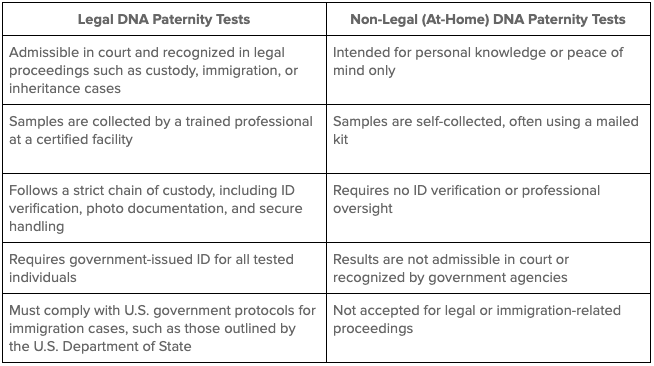
There are several types of DNA paternity tests, each designed for different situations. The key distinction lies in whether the results are intended for personal use or legal purposes. Understanding these differences is essential when deciding which type of test is best suited to your needs.
Legal vs. Non-Legal
Prenatal vs. Postnatal


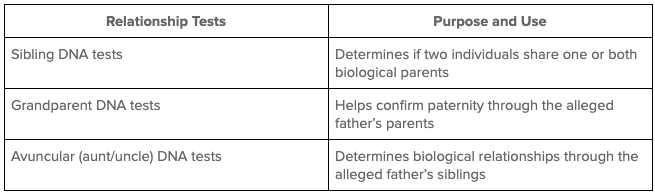
Other Relationship Tests
These alternative tests may be used when the alleged father is unavailable or deceased.
To be considered legally valid, a paternity test must be conducted at a certified facility under strict procedures — including chain of custody documentation and identity verification. Providers like Fastest Labs ensure that each legal requirement is met, so your results can be used in court or submitted to government agencies. However, alternative types of testing can provide indirect evidence of paternity and are especially useful in immigration or inheritance cases.
How to Choose the Right Paternity Testing Provider
Selecting the right paternity testing provider is essential to ensure your results are accurate, legally admissible, and delivered promptly, while also helping you avoid delays in legal or immigration proceedings.
Checklist: What to Look For in a Paternity Testing Provider
▢ AABB accreditation to meet legal and immigration standards
▢ Nationwide availability for convenient scheduling and collection
▢ Trained and supervised sample collectors
▢ Strict chain of custody procedures
▢ Fast turnaround times
▢ Secure and confidential results delivery
▢ Clear communication and support
Choosing a provider that meets these criteria, such as Fastest Labs, ensures your paternity test is legally sound and completed with confidence.
Legal Certainty Begins With Trusted Testing
A court-admissible paternity test offers clarity when it matters most — whether you’re preparing for a court hearing, navigating an immigration case, or correcting official documents.
Working with an accredited and experienced provider protects your legal rights and ensures your results hold up in any setting. Fastest Labs makes the process fast, straightforward, and secure.
Ready to take the next step? Find a Fastest Labs near you to schedule your court-admissible paternity test today.